

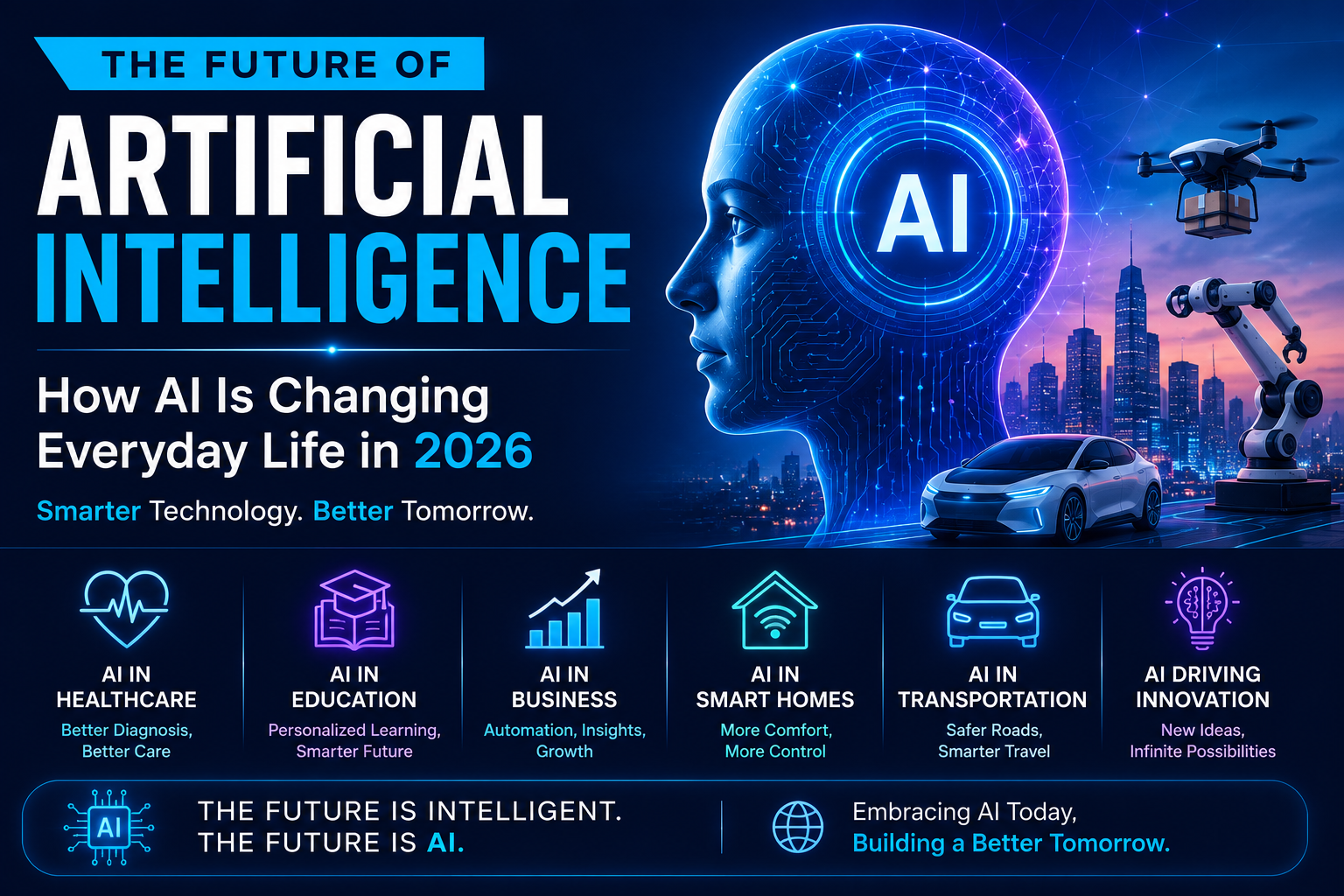
Artificial Intelligence (AI) has evolved from a futuristic concept into a practical technology that millions of people use every day. From voice assistants and personalized recommendations to medical diagnostics and autonomous systems, AI is becoming an essential part of modern life.
The Future of Artificial Intelligence promises even greater advancements. Businesses, governments, healthcare providers, educators, and consumers are embracing AI to improve efficiency, solve complex problems, and create new opportunities for innovation. Understanding how AI is shaping the future can help individuals and organizations prepare for the next wave of technological transformation.
What Is Artificial Intelligence?
Understanding AI Technology
Artificial Intelligence refers to computer systems that can perform tasks that normally require human intelligence, such as learning, reasoning, decision-making, language understanding, and image recognition.
Modern AI technologies include:
- Machine Learning
- Natural Language Processing (NLP)
- Computer Vision
- Robotics
- Generative AI
According to IBM AI, artificial intelligence enables computers to analyze large amounts of data and make intelligent decisions more efficiently.
AI in Healthcare
Artificial intelligence is transforming healthcare by improving diagnosis, treatment planning, and patient care.
Examples include:
- Medical image analysis
- Disease prediction
- Virtual health assistants
- Drug discovery
- Personalized treatment
Healthcare organizations increasingly use AI to improve accuracy and reduce administrative workloads.
The World Health Organization (WHO) also explores the responsible use of AI in healthcare to improve global health outcomes.
AI in Education
Educational institutions are using AI to create personalized learning experiences.
Benefits include:
- Adaptive learning platforms
- Automated grading
- AI tutoring systems
- Language translation
- Learning analytics
AI helps students learn at their own pace while giving teachers valuable insights into academic performance.
AI in Business
Businesses are adopting AI to automate repetitive tasks, improve customer service, and analyze market trends.
Common applications include:
- AI chatbots
- Customer support
- Marketing automation
- Fraud detection
- Sales forecasting
Companies using AI often improve productivity while reducing operational costs.
Microsoft provides practical examples of enterprise AI adoption through Microsoft AI.
AI in Smart Homes
Smart home devices use AI to improve convenience and energy efficiency.
Examples include:
- Voice assistants
- Smart thermostats
- Home security systems
- Smart lighting
- Energy management
These technologies continue to make everyday living more comfortable and efficient.
Challenges of Artificial Intelligence
Although AI offers many advantages, several challenges remain.
Privacy
Organizations must protect user data and ensure responsible AI practices.
Bias
AI systems should be trained using diverse datasets to reduce bias.
Cybersecurity
As AI adoption increases, businesses must strengthen digital security.
Google publishes best practices for responsible AI through Google AI.
The Future of AI
Experts believe artificial intelligence will continue influencing industries such as:
- Healthcare
- Finance
- Transportation
- Manufacturing
- Education
- Agriculture
Future developments may include more advanced robotics, autonomous vehicles, improved scientific research, and smarter digital assistants.
Organizations that invest in AI responsibly are likely to remain competitive in an increasingly digital world.
Conclusion
The Future of Artificial Intelligence is creating exciting opportunities across nearly every industry. From improving healthcare and education to enhancing business operations and everyday convenience, AI continues to reshape how people work and live.
As technology evolves, responsible development, ethical practices, and continuous learning will play essential roles in ensuring AI benefits society. Individuals and businesses that understand these changes today will be better prepared for tomorrow’s digital future.
Frequently Asked Questions
What is Artificial Intelligence?
Artificial Intelligence is technology that enables computers to perform tasks such as learning, reasoning, and problem-solving, which typically require human intelligence.
How is AI used in daily life?
AI powers voice assistants, recommendation systems, navigation apps, smart home devices, online shopping, healthcare tools, and customer service chatbots.
Will AI replace human jobs?
AI is expected to automate some repetitive tasks while also creating new job opportunities that require human creativity, problem-solving, and oversight.


