

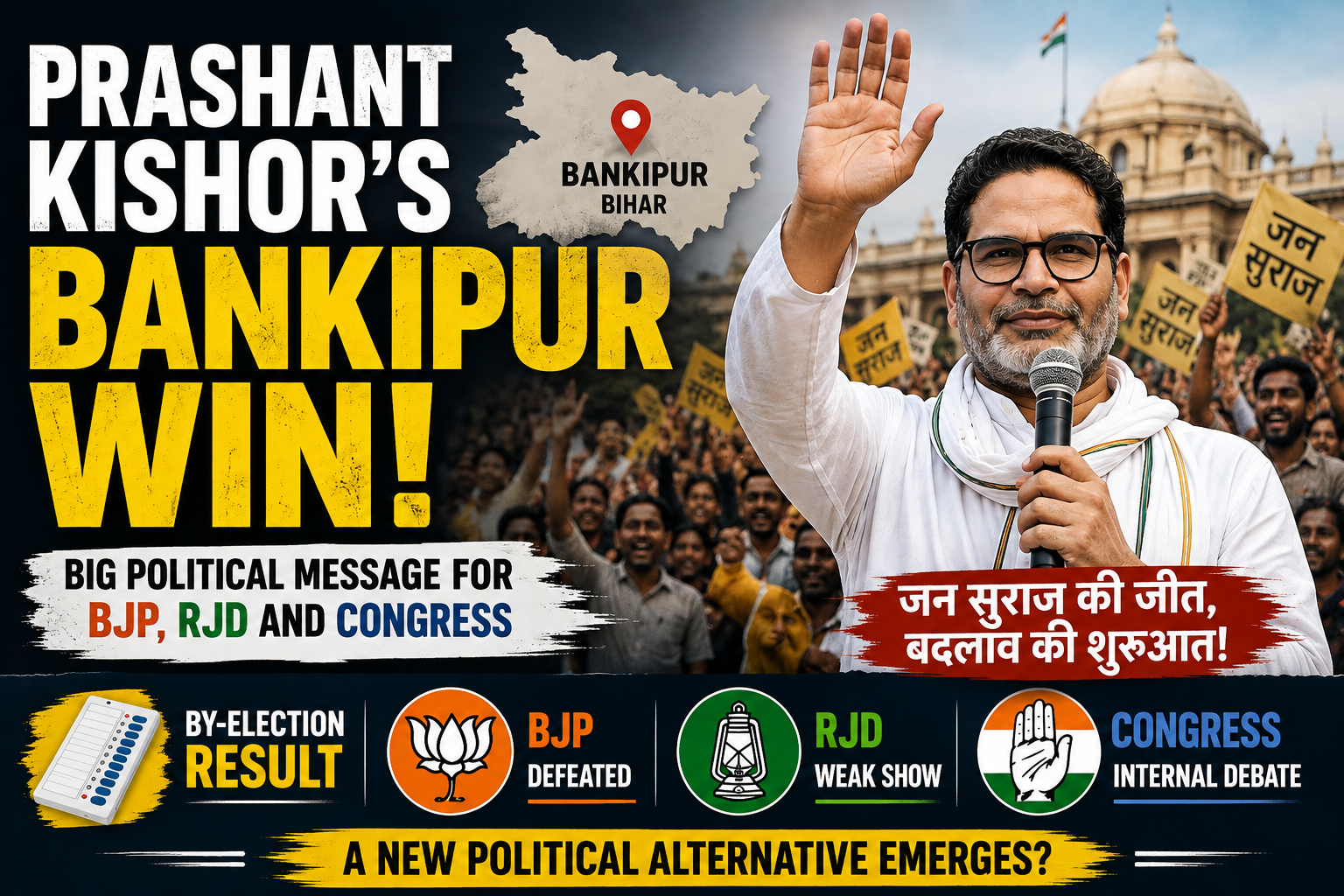
Prashant Kishor’s victory in the Bankipur Assembly bypoll has sparked fresh political discussions in Bihar, with leaders across the political spectrum examining what the result could mean for the BJP, RJD, Congress and the emerging Jan Suraaj Party.
The defeat of the BJP in Bankipur, considered a politically significant constituency in the heart of Patna, has attracted attention beyond the immediate bypoll result. While supporters of Prashant Kishor and his Jan Suraaj Party celebrated the victory, several political leaders viewed the outcome as a signal of changing voter preferences and growing dissatisfaction with established political alternatives.
For the BJP, the result represents a setback in a constituency that has traditionally been considered a stronghold. For the Opposition, however, the result has created a more complicated picture. While the BJP’s defeat was welcomed by several INDIA bloc leaders, the performance of the RJD also raised questions about the party’s position as the principal challenger to the BJP in Bihar.
Why Is Prashant Kishor’s Bankipur Win Important?
The Bankipur bypoll result has become a talking point because of the political importance of the constituency and the manner in which Prashant Kishor’s political movement has challenged established parties.
Bankipur is located in central Patna and has historically been a difficult seat for the RJD. The party has not won the constituency since 1995. In the latest bypoll, the RJD candidate reportedly secured just over 14,000 votes, raising concerns within the party about the possible erosion of its support base.
The result has also highlighted the growing space for political alternatives in Bihar. Prashant Kishor’s Jan Suraaj Party has attempted to position itself as a new political force, focusing on governance, development, employment and issues affecting young voters.
BJP Defeat Creates New Political Debate
The BJP’s loss in Bankipur has generated significant discussion because of the constituency’s political history and its association with the party’s organisational strength.
Opposition leaders and political observers have pointed to several possible factors behind the result. These include local issues, voter dissatisfaction and anger among sections of the electorate, particularly among upper-caste voters.
The result also comes amid wider political discussions surrounding youth-led movements and concerns over employment, competitive examinations and alleged paper leaks. These issues have increasingly become part of political conversations, particularly among younger voters.
However, it remains difficult to attribute the Bankipur result to a single factor. Local candidate selection, voter turnout, constituency-specific concerns and the nature of a bypoll can all influence the final outcome.
RJD Faces Questions After Bankipur Result
While the BJP’s defeat was welcomed by several Opposition leaders, the RJD’s performance presented a different challenge for the INDIA bloc.
The RJD has traditionally been one of the strongest political forces in Bihar and has sought to remain the main challenger to the BJP. However, its relatively weak performance in Bankipur has led to questions about whether emerging political forces such as Jan Suraaj could gradually affect its voter base.
Some political observers believe Prashant Kishor’s growing presence could create a new challenge for the RJD, particularly among voters looking for an alternative to both the BJP and established Opposition parties.
There is also speculation about the impact on Muslim voters, who have historically played an important role in Bihar elections. Political analysts believe that if Jan Suraaj succeeds in attracting voters who are primarily focused on defeating the BJP, it could potentially change the electoral calculations of the RJD and other Opposition parties.
However, RJD leaders have argued that Bankipur has never been a traditional stronghold for the party and that the political dynamics of a bypoll are different from those of a full Assembly election.
A senior RJD leader acknowledged that the result carried a message for the party but maintained that the outcome should be viewed in the context of the constituency’s history.
The party has indicated that it will study the result and make necessary course corrections to strengthen its political strategy.
Congress Leaders Debate Future Strategy in Bihar
The Bankipur result has also reignited an internal debate within the Congress over its political strategy in Bihar.
Some senior Congress leaders reportedly believe that the party should consider charting a more independent political course rather than relying heavily on its alliance with the RJD.
The argument within sections of the party is that the Congress needs to strengthen its own organisation and reconnect with voters across different sections of Bihar.
The emergence of Jan Suraaj has added another layer to this debate. If Prashant Kishor’s party continues to expand its presence, the Congress and RJD could face competition not only from the BJP-led alliance but also from a new political alternative seeking to attract voters dissatisfied with traditional parties.
Is Bankipur a Sign of Changing Bihar Politics?
The biggest question following Prashant Kishor’s Bankipur win is whether the result represents a larger shift in Bihar politics or is primarily a constituency-specific outcome.
Some Opposition leaders see a common political message connecting the Bankipur result with broader youth movements and the rise of new political forces in other states. According to this view, voters may be increasingly willing to experiment with alternatives to established parties.
The argument is that a section of the electorate, particularly young voters, is looking for new leadership and solutions to issues such as employment, education, examination reforms and governance.
However, other political leaders have cautioned against interpreting a single Assembly bypoll as evidence of a major statewide political transformation.
Bypolls often have unique dynamics. Candidate popularity, local issues, voter turnout and the mobilisation of party workers can significantly influence the result. Therefore, the real test for Jan Suraaj will be whether it can replicate its Bankipur performance across a larger number of constituencies.
Youth Vote Could Become a Key Factor
One of the most important aspects of the Bankipur result is the growing importance of youth concerns in electoral politics.
Issues surrounding paper leaks, government recruitment examinations, unemployment and education have become increasingly prominent in political debates. Young voters represent a significant section of the electorate, and their dissatisfaction can potentially affect the performance of established political parties.
Prashant Kishor and Jan Suraaj have attempted to build their political narrative around these concerns. The Bankipur result could therefore encourage the party to intensify its outreach among young voters.
For established parties, the message is equally important. The BJP, RJD and Congress may need to pay greater attention to employment, education and governance issues if they want to retain the support of younger voters.
What Does the Bankipur Result Mean for Bihar Politics?
The immediate impact of the Bankipur result is likely to be political rather than numerical.
For the BJP, the loss raises questions about its ability to retain support even in traditionally favourable constituencies.
For the RJD, the result is a reminder that it cannot take its position as the main Opposition force for granted.
For the Congress, the result could intensify discussions about whether it should strengthen its independent political identity in Bihar.
And for Prashant Kishor’s Jan Suraaj Party, the victory provides an opportunity to demonstrate that it can move beyond being a new political experiment and become a serious electoral force.
Can Prashant Kishor’s Jan Suraaj Repeat the Bankipur Success?
The biggest challenge for Prashant Kishor will be converting the Bankipur victory into a broader political movement.
Winning a single constituency is significantly different from building an organisation capable of contesting elections across Bihar. Jan Suraaj will need to develop a strong grassroots network, attract credible candidates and maintain voter support across different social and demographic groups.
The party’s ability to sustain its momentum will likely depend on whether it can translate its political message into a long-term electoral strategy.
If Jan Suraaj continues to gain support, Bihar’s traditional two-sided political competition could become more complicated, with voters potentially having another major option.
Read More :- Why Prashant Kishor’s Bankipur win may force Opposition into a rethink
Frequently Asked Questions
Who is Prashant Kishor?
Prashant Kishor is a political strategist who later entered active politics and launched the Jan Suraaj political movement in Bihar. His political campaign has focused on governance, development, education and employment.
Why is the Bankipur bypoll result significant?
The result is significant because the BJP lost a seat considered politically important in Patna, while the performance of the RJD also raised questions about the Opposition’s electoral strategy.
What is Jan Suraaj?
Jan Suraaj is the political movement led by Prashant Kishor, which aims to establish itself as an alternative political force in Bihar.
What does the Bankipur result mean for the RJD?
The result has prompted questions about the RJD’s ability to retain its position as the main challenger to the BJP, although party leaders have pointed out that Bankipur has historically not been an RJD stronghold.
Could Prashant Kishor’s party impact Bihar elections?
The Bankipur victory could strengthen Jan Suraaj’s political momentum. However, its long-term impact will depend on whether the party can expand its organisation and voter base across Bihar.
Conclusion
Prashant Kishor’s Bankipur victory has opened a new chapter in Bihar’s political conversation. The BJP’s defeat, the RJD’s performance and the growing discussion around Jan Suraaj have all created fresh questions for the state’s major political parties.
Whether the result marks the beginning of a larger political shift or remains a constituency-specific development will become clearer in future elections. For now, the Bankipur bypoll has delivered a clear message: established political parties can no longer ignore voter dissatisfaction, youth concerns and the growing demand for political alternatives.
The coming electoral battles will determine whether Prashant Kishor’s Bankipur win becomes an isolated success or the foundation of a broader political challenge in Bihar.