The way people search for information online is undergoing a major transformation. For more than two decades, Google has dominated the search industry, helping users find websites, products, services, and answers within seconds. However, the rise of AI-powered search tools such as ChatGPT, Google Gemini, Perplexity AI, and Microsoft Copilot is changing how people access information.
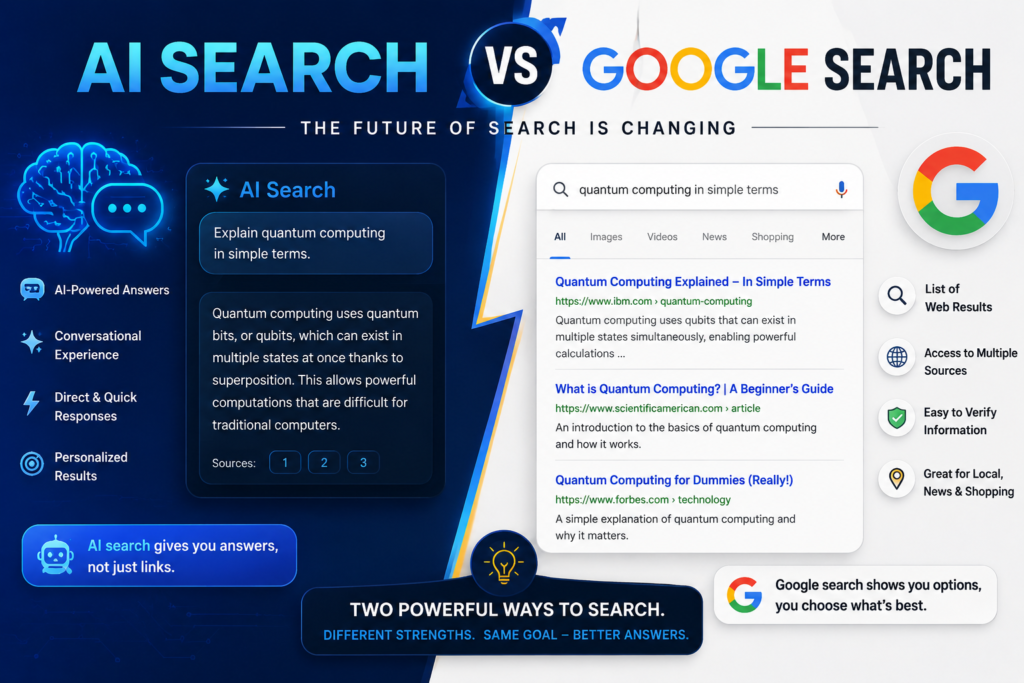
Instead of showing a list of links, AI search engines provide direct answers, summaries, and conversational responses. As a result, many experts are asking whether AI search could eventually challenge Google’s traditional search model.
What Is Traditional Google Search?
Google Search works by crawling and indexing billions of web pages across the internet. When a user enters a query, Google’s algorithms analyze relevance, authority, freshness, and hundreds of other ranking factors to display the most useful results.
Users typically click on multiple websites to gather information and compare sources.
According to Google’s official documentation, Search organizes information from across the web and helps users discover relevant content from trusted websites.
Source: Google Search Overview
https://www.google.com/search/howsearchworks/
What Is AI Search?
AI Search uses large language models (LLMs) and artificial intelligence to understand user questions and generate direct responses.
Instead of showing ten blue links, AI-powered search tools can:
- Answer questions directly
- Summarize complex topics
- Compare products and services
- Explain concepts in simple language
- Generate personalized responses
Popular AI search tools include:
- ChatGPT
- Google Gemini
- Perplexity AI
- Microsoft Copilot
These platforms allow users to have conversations rather than perform traditional keyword searches.
Source: Google Gemini Official Website
https://gemini.google.com
Key Differences Between AI Search and Google Search
| Feature | Google Search | AI Search |
|---|---|---|
| Results Format | List of websites | Direct answers |
| Information Source | Indexed web pages | AI-generated summaries |
| User Experience | Search and browse | Conversational |
| Follow-up Questions | Requires new searches | Natural conversations |
| Research Speed | Multiple sources needed | Faster summaries |
| Source Verification | Easy to verify websites | Requires additional fact-checking |
Both approaches offer advantages depending on the user’s needs.
Why AI Search Is Becoming Popular
AI search tools have gained millions of users because they simplify the research process.
Faster Answers
Users no longer need to open multiple tabs to find information. AI can provide summarized responses within seconds.
Better User Experience
AI search feels more like talking to a knowledgeable assistant than using a traditional search engine.
Personalized Responses
AI can tailor explanations based on context, making information easier to understand.
Productivity Benefits
Professionals, students, and businesses use AI tools to save time when researching topics or generating content.
According to Microsoft, AI-powered assistants are helping users complete tasks more efficiently through natural language interactions.
Why Google Search Still Dominates
Despite the growth of AI search, Google remains the world’s most popular search engine.
There are several reasons why:
Access to Original Sources
Google directs users to the original websites where information is published.
Real-Time Information
Search engines often provide faster access to breaking news, live events, and frequently updated information.
Product and Local Searches
Google excels at helping users find businesses, products, reviews, maps, and services.
Trust and Verification
Users can compare multiple sources before making decisions.
For important topics such as health, finance, or legal advice, many users still prefer reviewing information directly from trusted websites.
The Impact on SEO and Website Traffic
The rise of AI search is creating significant changes in the SEO industry.
Website owners and publishers are noticing shifts in how users consume content.
To remain visible, websites should focus on:
- Original content
- Expert insights
- Accurate information
- Strong user experience
- Authoritative sources
- Structured content
Google has repeatedly emphasized the importance of creating helpful, people-first content rather than content created solely for search rankings.
Source: Google Search Central
https://developers.google.com/search
Challenges Facing AI Search
Although AI search offers many advantages, it also faces several challenges.
Accuracy Issues
AI models can occasionally generate incorrect information, commonly known as AI hallucinations.
Source Attribution
Some AI tools summarize content without clearly highlighting original sources.
Misinformation Risks
Users may trust AI-generated answers without verifying facts.
Privacy Concerns
Questions remain about how user interactions and data are processed by AI systems.
These challenges are pushing technology companies to improve transparency and reliability.
Google’s Response to the AI Search Revolution
Google is not standing still.
The company has integrated AI-generated overviews directly into Search results and continues expanding Gemini across its ecosystem.
Rather than replacing traditional search, Google appears to be combining AI capabilities with its existing search infrastructure.
This hybrid approach aims to provide:
- Faster answers
- Better research experiences
- Access to original sources
- Improved user satisfaction
According to Google’s AI announcements, the goal is to help users discover information more efficiently while continuing to support content creators and publishers.
Will AI Search Replace Google Search?
Most industry experts believe AI search and traditional search will coexist rather than completely replace one another.
AI search is ideal for:
- Quick answers
- Summaries
- Brainstorming
- Research assistance
Traditional search remains better for:
- News updates
- Shopping
- Local business searches
- Source verification
- Detailed research
The future of search is likely to combine the strengths of both technologies.
Frequently Asked Questions (FAQs)
What is AI Search?
AI Search uses artificial intelligence to provide direct answers and summaries instead of displaying only website links.
Is AI Search better than Google Search?
It depends on the task. AI Search is faster for summaries, while Google Search is often better for finding original sources and real-time information.
Can ChatGPT replace Google Search?
ChatGPT can answer many questions, but Google Search remains more effective for news, shopping, maps, and source verification.
What are the most popular AI Search tools?
Popular AI search platforms include ChatGPT, Google Gemini, Perplexity AI, and Microsoft Copilot.
Does AI Search affect SEO?
Yes. AI search is changing how users discover content, making high-quality, authoritative content more important than ever.
Will websites lose traffic because of AI Search?
Some websites may experience changes in traffic patterns, but valuable, original content will continue to attract users and citations from search engines and AI systems.
Conclusion
The battle between AI Search and Google Search is shaping the future of how people find information online. While AI-powered tools offer faster answers and a more conversational experience, traditional search engines continue to provide unmatched access to original sources, real-time updates, and trusted information.
Rather than replacing one another, AI search and traditional search are likely to evolve together, creating a smarter and more efficient search experience for users worldwide.